Zum Inhalt springen


Intereconomics, 61(4), 240–248
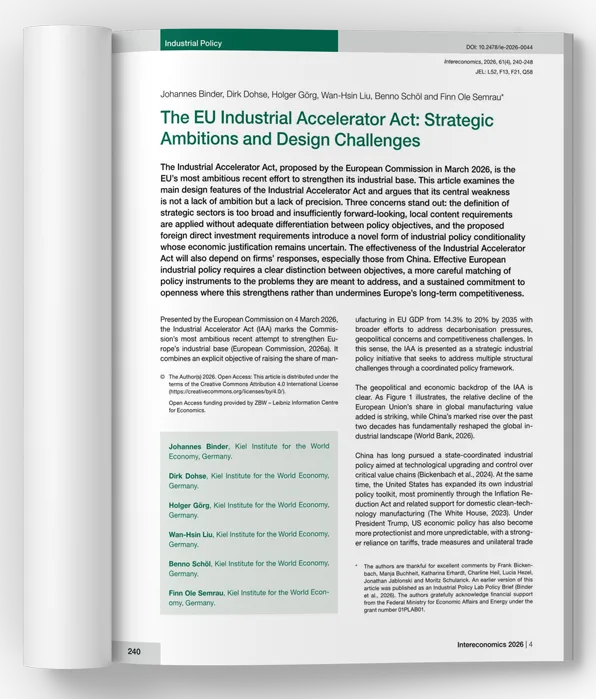
The Industrial Accelerator Act (IAA), proposed by the European Commission in March 2026, is the EU’s most ambitious recent effort to strengthen its industrial base. This article examines the Act’s main design features and argues that its central weakness is not a lack of ambition but a lack of precision. Three concerns stand out: the definition of strategic sectors is too broad and insufficiently forward-looking; local content requirements are applied without adequate differentiation between policy objectives; and the proposed foreign direct investment requirements introduce a novel form of industrial policy conditionality whose economic justification remains uncertain. The effectiveness of the IAA will depend heavily on firms’ responses, especially those from China. Effective European industrial policy requires a clear distinction between objectives, a more careful matching of policy instruments to the problems they are meant to address, and a sustained commitment to openness where this strengthens rather than undermines Europe’s long-term competitiveness.
Autoren
Binder J., Dohse D., Görg H., Liu W.-H., Schöl B., Semrau F.O.
Erscheinungsdatum
07/2026
JEL Classification
L52, F13, F21, Q58